On screen and in real life
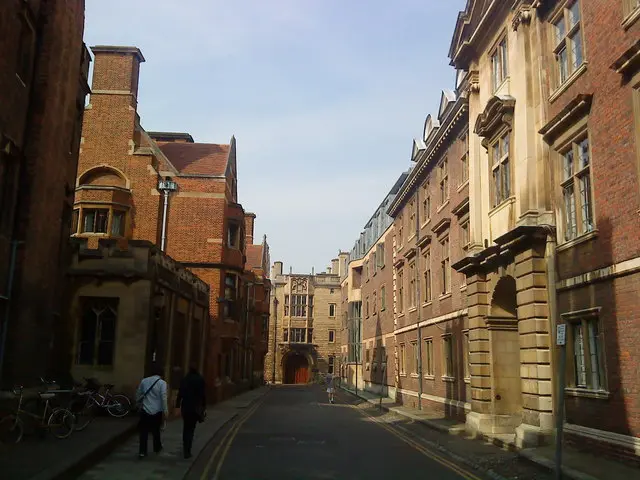
Queens’ Lane, Cambridge
Ludwig Series 1 Episode 1 follows John Taylor as he tackles his first murder inquiry while impersonating James. The recap and ending are kept inside the spoiler reveals below.
Watch on iPlayerLast checked 27 October 2026 · Sources & corrections
Lucy asks John Taylor to impersonate his missing twin, DCI James Taylor, to retrieve a notebook from the police station. His visit draws him into the murder of conveyancing solicitor Alan Howells at an office building. The deception gives John access to James’s Major Investigations Team and to a workplace full of guarded colleagues, competing loyalties and carefully timed movements. David Mitchell introduces John as a brilliant puzzle setter with no police experience, while Anna Maxwell Martin’s Lucy keeps the search for James moving beyond the official inquiry. The episode establishes the Cambridge family home, police headquarters and the procedural rhythm that will shape the series. John must learn how detectives question witnesses while spotting the logical weakness hidden inside an apparently ordinary working day. The central office suspects are connected by professional rivalries and private grievances. The case can be followed without knowing its solution; the larger hook is whether John can survive inside his brother’s identity long enough to discover why James disappeared.
John Taylor arrives in Cambridge because his sister-in-law Lucy says that his identical twin, Detective Chief Inspector James Taylor, has disappeared. Lucy needs somebody with James's face to enter the police station and recover a notebook, and the intensely private puzzle setter reluctantly agrees. The deception is supposed to last minutes. Instead, DI Russell Carter collects him for a murder inquiry at a modern office block, where a solicitor has been found stabbed beside his desk after the working day appeared to end normally. John must imitate a brother whose colleagues, habits and job he barely knows while examining a room full of strangers.
The office supplies a crowded field of suspects, including Sarah Gilmarsh. Staff accounts divide the afternoon into innocuous events: a fire door is opened, paperwork is signed, a telephone call delays the victim and people use the stairs as the building empties. Each action looks too ordinary to matter. John sketches the workers' positions and treats their movements as a logic grid. He is less interested in who sounds nervous than in who could occupy every necessary place without contradicting a witness or the physical route through the building.
Three interventions create the killing window. Opening the fire door causes a distraction, giving somebody time to forge the victim's signature. A later call prevents him leaving when expected. Finally, the killer reaches the stairwell at the point when the remaining workers are departing, allowing the fatal attack to be folded into routine movement. John tests the candidates against all three moments. Only Sarah can be present for the complete sequence, and he identifies her in front of the group. The apparent mystery was not an invisible assailant but a planned chain whose components had been reported separately.
Solving the case makes John's impersonation harder to abandon. Carter and the team read his oddness as James behaving unusually after a difficult period; John discovers that applying crossword discipline to people can produce a real arrest. He also sees how much authority James's name carries, which makes every hesitation dangerous. Lucy, waiting outside the official inquiry, has gained a route into the station but also placed John inside a live investigation that can expose them both.
Back in James's office, John locates the notebook that prompted the masquerade. Its contents are not an ordinary diary: the pages use codes and puzzle-like marks that appear designed for somebody able to recognise James's intellectual habits. That discovery changes the family question. James may have left a deliberate trail rather than simply walked away, and John is probably the intended reader. Lucy and Henry still have no answer about where he went, but they now possess the first object that might connect his police work to his disappearance. The episode closes its office murder while opening the larger casebook: John has a solved crime, a borrowed identity and a message from his missing twin that he cannot yet read.
The opening investigation also establishes the limits of John's method. He does not recover a hidden forensic sample or catch the killer in a conventional interview; he makes the timetable understandable enough that Sarah believes her route has been seen. Alice watches a supposed senior officer solve the case with diagrams while Simon responds enthusiastically to every strange instruction. Carter wants a usable answer, not an elegant puzzle, and the distinction will matter throughout John's time with the team. For Lucy, every extra minute at the office raises the risk that a colleague will ask something only James could know. The successful accusation therefore solves the solicitor's death while turning a short burglary of James's desk into an identity John must continue performing.
Sarah Gilmarsh killed the solicitor. John places every suspect against three linked events: the fire-door distraction that enabled a forged signature, the telephone call that delayed the victim, and the stairwell movement at the end of the day. Sarah is the only person who can fit all three positions.
Key clue: one person, Sarah, can be present at each of the three apparently unrelated interventions.
Red herring: treating the fire door, call and stairwell traffic as separate pieces of office routine.
John finds James's coded notebook in the police office. Its deliberate puzzle structure suggests that James left a trail for somebody capable of reading it, turning his absence into an investigation rather than a simple disappearance.
An office closes for the night; a later view reveals a body. John then completes breakfast puzzles. The opening puts a crime beside a solver who has yet to meet it.
Alan is a conveyancing solicitor. Alice first considers a professional hit, but his work gives Carter reason to question that idea. John compares seven people’s movements against the alarm, call and killing. Sarah fits all three; she confesses.
Simon calls Alice to watch John’s demonstration. Carter praises the result. Their reactions establish professional confidence in the man they think is James, without revealing his substitution.
Henry initially believes his father is away working, then discovers the letter. Lucy has already recruited John to recover the orange notebook. Keep those different levels of knowledge separate when following the family scenes.
Based on What to Watch’s Episode 1 recap, 2024-09-25. Checked 27 October 2026. These are selected story beats, not a shot-by-shot timeline.
Ludwig Season 1 Episode 1 (Series 1 Episode 1) includes filming on Queens’ Lane in Cambridge. The lane appears in the opening drive, while the wider series uses Stockley Park for police-station exteriors and Ham, Richmond, for the Taylor home.
Explore the verified and carefully identified places used for this episode.
You can see the exterior route without a ticket. The lane is narrow and college entrances are separate controlled spaces.
Episode match: Find That Location’s Series 1 guide. Visitor information checked 19 September 2026. Full scene/scene details .
Credits from the BBC and Big Talk Studios. Review the supporting source record →
Main cast across the series. Individual episode appearances vary.
Sarah Gilmarsh killed the solicitor. John places every suspect against three linked events: the fire-door distraction that enabled a forged signature, the telephone call that delayed the victim, and the stairwell movement at the end of the day. Sarah is the only person who can fit all three positions.
one person, Sarah, can be present at each of the three apparently unrelated interventions.
The story uses a Cambridge office and police headquarters. See the linked location section and location guides for verified real-world matches.
In the UK, check the current Ludwig programme page on BBC iPlayer. Availability can change; North American viewers should check BritBox.
For current viewing and home-video options, see How to watch Ludwig.
Episode premise and cast checked against What to Watch’s Episode 1 recap and British Comedy Guide’s Episode 1 credits. Felicity Kendal’s Lady Camilla Bryce appears in Episode 2.
How we check: every fact on this page is taken from the BBC, the production companies or named, dated reports. See our sources and method or send a correction.
